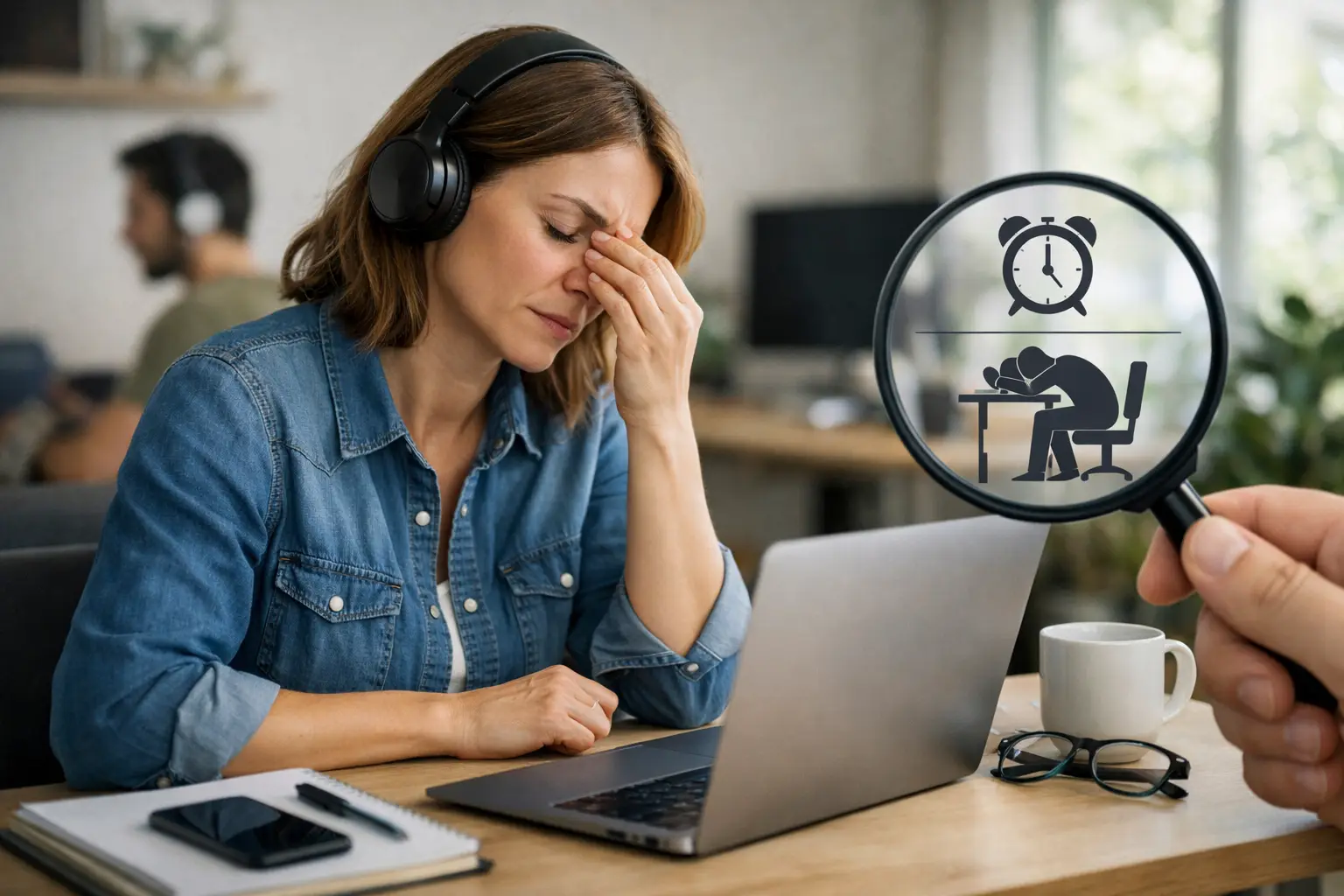
You can buy a better chair, raise your screen, stretch between calls, and still hit 2 p.m. feeling like your brain just left the meeting. That is exactly why a real remote worker fatigue assessment matters. If your energy keeps collapsing even after you fix the obvious setup issues, the problem is probably not just your desk. It is more likely a deeper control-system imbalance that shows up as fatigue, brain fog, poor sleep, tension, and low output.
Most remote workers get trapped in the same cycle. They assume fatigue comes from long hours, too much screen time, or weak discipline. So they try coffee, supplements, blue-light glasses, standing desks, and productivity hacks. Sometimes those help for a week. Then the same symptoms come back, because the body was never properly assessed in the first place.
What a remote worker fatigue assessment should actually measure
A useful assessment does not stop at asking whether you feel tired. That tells you almost nothing. Fatigue is not a diagnosis. It is a signal. The real question is what system is driving it.
For laptop-based workers, fatigue often travels with a pattern. Sleep gets lighter. Focus drops faster. Mid-back or neck tension starts creeping in. You feel wired late at night and flat in the morning. Digestion may get irregular when you travel. Motivation drops even when your workload has not changed. Those clues matter because they point to a body that is losing control efficiency, not just a person who needs another break.
That is where generic wellness advice fails. It treats fatigue like a lifestyle mood problem. A real assessment looks at symptom clusters, timing, stress response, sleep quality, pain patterns, and how those signals map to deeper imbalance. Precision matters because two remote workers can both feel exhausted for completely different reasons.
One person may be stuck in a stress-driven pattern that keeps the nervous system overactivated. Another may have a lower-body imbalance affecting circulation and tension load. Another may be dealing with digestive strain from travel, irregular meals, and work compression. The symptom of fatigue is shared. The mechanism is not.
Why posture-only answers miss the real problem
The internet loves a simple villain, and posture has become the favorite one. If you are tired, fix your posture. If your back hurts, fix your posture. If your focus is bad, sit correctly. That story sells because it is easy. It is also incomplete.
Posture matters, but posture is often an output, not the root cause. When your control system is under strain, the body starts compensating. Muscles overwork. Breathing changes. Sleep gets less restorative. Recovery drops. You slump more not because you forgot the rules, but because the system underneath the structure is losing balance.
That distinction changes everything. If your fatigue comes from a deeper internal imbalance, ergonomic upgrades may reduce friction without solving the main issue. You might feel slightly better while the real pattern keeps building. That is why so many remote workers keep chasing setup fixes while their energy, sleep, and mental clarity continue to slide.
The hidden pattern behind remote work fatigue
Remote work looks flexible from the outside. Inside the body, it can be brutally repetitive. Long sitting, unstable schedules, constant low-grade cognitive load, travel disruptions, and shallow recovery all add up. The body does not care that you are working from Lisbon, Austin, or a beach town in Mexico. If the control system is overloaded, symptoms will show up.
In the Concept Therapy framework, recurring fatigue is not viewed as an isolated complaint. It is interpreted through zone-based imbalance patterns. That matters because symptoms rarely travel alone. The worker who complains about low energy may also have headaches, poor sleep, jaw tension, irritability, lower back tightness, or gut disruption. Those are not random side issues. They are part of the same pattern.
A structured fatigue assessment should help you see that pattern fast. It should not leave you with vague advice like manage stress better or move more. You already know that. What you need is a way to identify which symptom cluster is dominant so corrective action is specific, not random.
What to look for in a remote worker fatigue assessment
If an assessment is worth your time, it should do three things. First, it should connect fatigue to related symptoms instead of treating tiredness as a standalone issue. Second, it should sort those symptoms into an organized framework so you can see what is primary and what is secondary. Third, it should lead to a practical next step.
That means the right assessment will ask about more than energy levels. It will look at sleep timing, sleep depth, brain fog, pain distribution, recovery after work, mood shifts, digestive irregularity, and the way symptoms change during travel or high-output weeks. It should also reveal whether your current issue is likely mechanical, neurological, systemic, or a mix.
This is where short symptom audits can be useful. A brief scan can surface the dominant pattern and tell you whether your fatigue is probably connected to upper-zone stress load, lower-zone instability, digestive strain, or another recurring imbalance type. A deeper assessment should go further by ranking symptom intensity, showing overlap, and guiding a more tailored corrective path.
Why quick fixes keep failing
Most high-performing remote workers are not lazy. They are overcorrecting in the wrong direction. When fatigue hits, they add stimulants, buy gear, push workouts harder, or force stricter routines. Those moves can create a short-term lift, but they can also mask the underlying imbalance.
There is a trade-off here. Surface fixes are convenient and sometimes necessary. If your workspace is terrible, improving it helps. If your sleep schedule is chaos, stabilizing it helps. But when the body has already shifted into a chronic fatigue pattern, lifestyle cleanup alone may not be enough. You need targeted correction based on the pattern your body is actually expressing.
That is why assessment comes before optimization. Without it, every solution is a guess. And guessing gets expensive when it costs your work quality, travel freedom, and ability to feel normal in your own body.
A better way to use your symptoms
Your symptoms are not interruptions. They are data. Brain fog after long laptop sessions, waking up tired, feeling heavy after meals, losing focus late afternoon, or getting tight through the neck and low back are not separate annoyances to manage one by one. They are clues that your system is compensating.
A strong remote worker fatigue assessment helps you stop thinking in fragments. Instead of asking, Why am I tired lately, you start asking, What symptom pattern is driving this fatigue, and what does that reveal about my primary imbalance?
That shift is where real momentum starts. Once you know the pattern, decisions get simpler. You can stop cycling through generic wellness advice and focus on the correction that fits your body.
For some people, that means starting with a fast symptom scan to identify the likely zone under the most strain. For others, especially those dealing with fatigue plus pain, sleep disruption, and recurring brain fog, a deeper assessment makes more sense because overlap is common. The more chronic the pattern, the less useful guesswork becomes.
The Zone System Health Portal is built around that logic. Instead of throwing posture tips at a systemic problem, it uses structured symptom assessment to identify the dominant imbalance and point you toward the right corrective path.
What to do next if you are constantly tired while working remote
Start by getting honest about the pattern. If your fatigue has lasted more than a few weeks, keeps returning after rest, or comes with sleep issues, tension, pain, digestive changes, or mental fog, stop calling it normal. It is common, but common is not the same as healthy.
Then choose assessment over assumption. A fast symptom audit can give you direction quickly. A deeper one can help verify what is primary and what is just compensation. That matters because the right correction depends on the right interpretation.
If your issue is mild and recent, simple changes may move the needle. If your fatigue is chronic, layered, or interfering with work and travel, you need more precision than a hydration reminder and a standing desk can offer.
You do not need another generic wellness lecture. You need a clear read on what your body is signaling so you can respond with something smarter than more caffeine and better posture. The sooner you measure the pattern, the sooner you stop fighting the wrong problem.
Educational Disclaimer: This article is authored by Dr. Chris Bowe, D.C. for educational and biomechanical wellness purposes only. It is not intended as medical advice or formal surgical diagnosis. Always consult a licensed healthcare practitioner regarding persistent pain or health conditions.
Dr. Chris Bowe, D.C.
Licensed DCDoctor of Chiropractic • Founder of DeskReliefNow
Dr. Chris Bowe is a licensed Doctor of Chiropractic with over two decades of clinical experience in spinal biomechanics, neurophysiology, and posture correction for remote professionals.