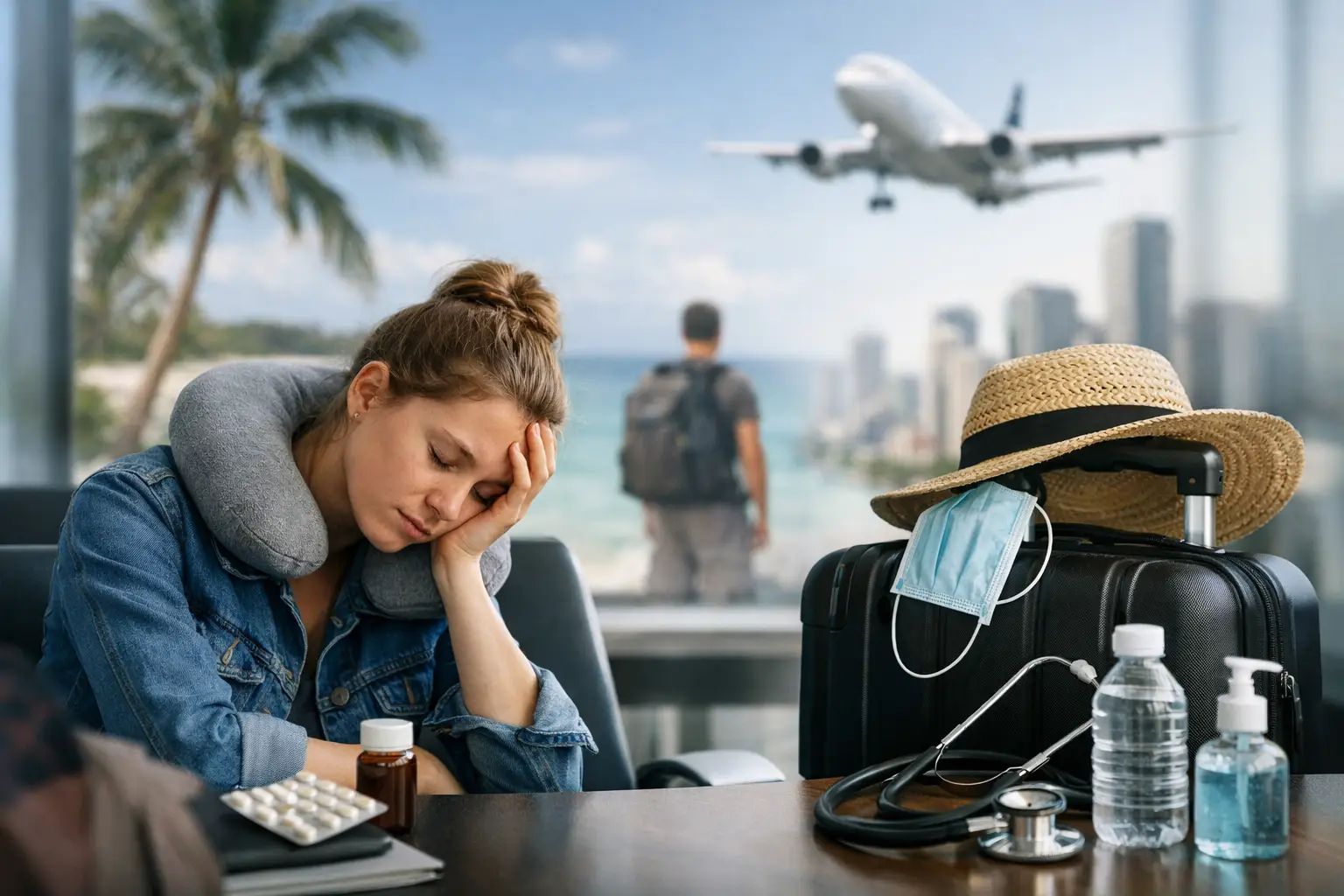
You didn’t choose freedom so you could feel worse in better locations. Yet that is exactly how travel lifestyle health problems show up for a lot of remote workers and digital nomads. One month it’s back tightness after flights. Next it’s brain fog in the middle of a work block, broken sleep in a great apartment, or low energy that coffee can’t fix.
Most people blame the obvious stuff - bad chairs, jet lag, weak core, poor posture, too much screen time. Those things matter, but they are rarely the full story. If your symptoms keep repeating across cities, time zones, and setups, the problem is probably not just your environment. It is more likely that travel is exposing a deeper imbalance in the body’s control system.
Why travel lifestyle health problems keep following you
Here’s the pattern most people miss. Travel does not create every symptom from scratch. It amplifies what is already unstable.
Long sitting hours, airport stress, sleep disruption, irregular meals, dehydration, and constant adaptation demands all put pressure on the nervous system. If your body is already compensating, that extra pressure can push hidden dysfunction into obvious symptoms. That is why two people can take the same flight, work from the same cafe, and have completely different outcomes. One feels fine. The other gets neck tension, anxiety, constipation, low motivation, and a three-day energy crash.
This is where generic advice starts to fail. Stretch more, buy a lumbar cushion, stand up every hour, drink more water - useful, yes. Precise, no. They treat the visible friction, not the source of the recurring pattern.
For a mobile worker, that distinction matters. If you are changing countries, beds, workstations, and routines every few weeks, you cannot afford a health strategy built on guesswork. You need to know what system is breaking down first.
The real issue is often body control, not just posture
A common mistake is reducing every travel-related symptom to mechanics alone. Your back hurts, so your chair must be bad. Your shoulders lock up, so your desk height must be wrong. Your focus drops, so you need a productivity app and fewer tabs.
That logic is too shallow.
The body runs through coordinated control systems. When one zone of that system loses efficiency, symptoms can spread far beyond the obvious area. A control issue in one region can alter muscular tension, breathing patterns, digestion, sleep quality, circulation, and mental clarity. The result looks random when it isn’t.
This is why someone can chase massage, mobility work, supplements, and ergonomic gear and still feel off. They are trying to calm the output while ignoring the controller.
In Concept Therapy language, symptoms often cluster around Biological Zone imbalances. That framework matters because it gives structure to what otherwise feels chaotic. Instead of seeing pain, fatigue, poor sleep, and fog as four unrelated problems, you start asking a better question: which zone is losing control and forcing the body to compensate?
That question is far more useful than asking whether your Airbnb chair has enough support.
The travel lifestyle health problems that signal deeper imbalance
The signs are usually not dramatic at first. They are persistent, annoying, and easy to normalize.
You wake up tired even after enough time in bed. Your low back gets stiff during focused work, but stretching only helps for an hour. You feel wired at night and flat in the morning. Your digestion changes every time you travel, and your focus becomes unreliable. You may also notice headaches, shallow breathing, restlessness, leg tension, chest tightness, or a drop in stress tolerance.
Seen separately, these look like standard travel issues. Seen together, they point to poor adaptation capacity.
That distinction matters because adaptation is the whole game for digital nomads. Your body is constantly being asked to recalibrate to new light exposure, movement levels, food timing, seat pressure, stress loads, and sleep windows. If the control system is already unstable, every move becomes a tax. The symptom that finally gets your attention might be neck pain, but the bigger issue may be neurological overload, poor zone coordination, or systemic compensation that has been building for months.
Why healthy habits still fail on the road
A lot of high-functioning travelers do the right things and still feel bad. They train. They track sleep. They eat clean. They carry supplements. They book places with gyms. Still, symptoms creep in.
That does not mean the habits are useless. It means they may be too general for the problem.
If your primary imbalance sits in a specific control zone, broad healthy behaviors may only maintain function without correcting it. You can be disciplined and still be compensating. In fact, disciplined people often get stuck longer because they assume effort should be enough.
It depends on how far the imbalance has progressed. For some people, better sleep timing and less sitting can reduce symptoms fast. For others, the issue is no longer just workload or travel rhythm. The body has adapted around dysfunction, and generic health habits stop producing meaningful change.
That is when precision becomes more valuable than motivation.
A better way to look at recurring symptoms
Instead of asking, “What hack should I add?” ask, “What pattern keeps repeating?”
Look for symptom combinations, not isolated complaints. Does your back pain rise with brain fog? Does poor sleep come with digestive slowdown? Do flights trigger anxiety and shoulder tension together? Does a productive work sprint leave you exhausted instead of focused?
Patterns reveal control problems. Random tips do not.
Once you identify the likely zone or system under strain, you can make smarter choices. That may include corrective exercises, changes in sitting exposure, breathing retraining, workload pacing, or a more targeted recovery plan. The point is not to do more. The point is to stop treating every symptom as a separate fire.
This is where a structured assessment beats self-diagnosis through social media clips and wellness trends. You do not need more content. You need a map.
What to do if your travel lifestyle health problems are getting worse
Start by dropping the idea that pain or fatigue is just the cost of mobility. It is not normal to build a freedom-based life and lose your ability to enjoy it.
Next, stop assuming the answer is purely ergonomic. Better setups help, but they do not explain why symptoms persist even when you upgrade your chair, standing desk, mattress, or routine. If the same issues keep returning in different environments, the problem is traveling with you.
Then get specific. Audit your symptoms in clusters. Track when they appear, what they overlap with, and what seems to trigger them. Pay attention to sleep quality, bowel changes, stress tolerance, breathing depth, concentration, and where tension accumulates first. Those details matter because they can point to a primary imbalance rather than a dozen disconnected issues.
From there, use a framework that organizes symptoms by control patterns, not just by body parts. That is the difference between endless trial and error and a useful next step. The Zone System Health Portal is built for exactly this kind of person - someone functioning well enough to keep moving, but not well enough to ignore what their body is signaling.
Why speed matters more than people think
A lot of travelers wait too long because their symptoms are intermittent. If the pain comes and goes, if energy dips only hit after flights, or if sleep gets weird only in certain places, it is easy to delay action.
That is a mistake.
Intermittent symptoms often mean your system is still compensating. Once compensation weakens, the problem becomes harder to ignore and usually harder to correct. What starts as stiffness and mild fatigue can turn into chronic pain, unstable mood, insomnia, or major productivity loss.
For a location-independent worker, that carries a real cost. You miss deep work sessions. You recover slower. You become less resilient under pressure. The lifestyle that was supposed to expand your freedom starts shrinking your capacity.
That is why precision assessment matters early, not just after things get bad.
The goal is not symptom management. It is better control.
If you want fewer travel lifestyle health problems, stop chasing temporary relief as your main strategy. Relief is fine. Better control is better.
When the body’s control system is functioning well, travel stress becomes manageable. You recover faster from flights. You sit longer without paying for it later. Sleep stabilizes more easily. Focus becomes more reliable. You stop feeling like every move, every workspace, and every timezone shift is taking something out of you.
That is the real target - not perfection, but resilience with structure.
You built your life around movement, freedom, and flexibility. Your health strategy should match that standard. If your symptoms keep repeating, your body is not asking for another generic wellness tip. It is asking for a more accurate explanation.
Educational Disclaimer: This article is authored by Dr. Chris Bowe, D.C. for educational and biomechanical wellness purposes only. It is not intended as medical advice or formal surgical diagnosis. Always consult a licensed healthcare practitioner regarding persistent pain or health conditions.
Dr. Chris Bowe, D.C.
Licensed DCDoctor of Chiropractic • Founder of DeskReliefNow
Dr. Chris Bowe is a licensed Doctor of Chiropractic with over two decades of clinical experience in spinal biomechanics, neurophysiology, and posture correction for remote professionals.